
MinistryCentral Europe
This document defines the standard workflow for creating, reviewing, approving, and publishing documentation within MinistryCentral Europe.
It describes how work moves, not who holds authority or when content becomes canonical. Those aspects are defined in:
- Canonical Authority Model
- Status Lifecycle & Canonical Rules
- Change Management Rules
This workflow applies to all documentation, including onboarding guides, governance documents, instructional material, and operational references.
1. Purpose
The Documentation Workflow exists to:
- Enable safe, distributed contribution
- Ensure consistent review and approval
- Prevent accidental publication or authority drift
- Provide clarity on where work happens at each stage
- Reduce friction for contributors and editors
It answers the question:
“What is the next step, and where does it happen?”
2. Core Workflow Principle
Work flows forward through defined stages; authority is applied at specific transition points.
No single tool or role completes the entire workflow alone.
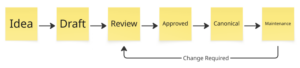
3. Standard Workflow Overview
All documentation follows this sequence:
- Idea / Proposal
- Drafting
- Review
- Approval
- Canonical Publication
- Maintenance or Change
Each stage has:
- A primary location
- Clear role ownership
- Explicit exit conditions
4. Workflow Stages (Detailed)
Stage 1 — Idea / Proposal
Purpose: Capture intent and scope
Where it happens:
- Informal notes
- Notion pages
- Conversation summaries
Who participates:
- Contributors
- Editors
- Coordinators
- Instructors
Rules:
- No formal structure required
- No authority implied
- Ideas may be discarded freely
Exit condition:
- Decision to proceed with drafting
Stage 2 — Drafting
Purpose: Create working content
Where it happens:
- Notion (preferred)
- Word or other editors (acceptable)
Who participates:
- Contributors
- Editors
- Subject-matter authors
Rules:
- Content must be clearly marked as Draft
- Meaning may evolve freely
- Multiple iterations are expected
- No publication to Echo KB
Exit condition:
- Content is substantively complete and ready for review
Stage 3 — Review
Purpose: Evaluate quality, alignment, and correctness
Where it happens:
- Notion (comments, revisions)
- Designated review environment
Who participates:
- Content Editors
- Coordinators or Leads
- Subject authorities (as needed)
Rules:
- Feedback must be visible or documented
- Review focuses on:
- Clarity
- Consistency
- Alignment with governance
- Content remains non-canonical
Exit condition:
- Consensus that content is ready for approval
Stage 4 — Approval
Purpose: Apply canonical authority
Where it happens:
- Explicit confirmation by authorized role
- Documented via status, note, or record
Who participates:
- Role holders defined in the Canonical Authority Model
Rules:
- Approval must be explicit
- Approval freezes meaning
- Approval does not automatically publish content
Exit condition:
- Content is approved and eligible for canonical residence
Stage 5 — Canonical Publication
Purpose: Establish official reference
Where it happens:
- Echo Knowledge Base
Who participates:
- Editors (publication)
- Platform / Admin roles (system integrity)
Rules:
- Echo KB is the primary canonical residence
- Published content must reflect the approved version exactly
- Any discrepancy must be corrected immediately
Exit condition:
- Content is live and authoritative
Stage 6 — Maintenance or Change
Purpose: Sustain accuracy over time
Where it happens:
- Monitoring in Echo KB
- Proposed changes drafted in Notion
Who participates:
- Editors
- Coordinators
- Platform roles (as applicable)
Rules:
- Non-substantive fixes may be applied carefully
- Substantive changes must follow:→ Change Management Rules
- Deprecated content must be clearly marked
Exit condition:
- Content remains current, or
- Content is superseded or archived
5. Tool Usage Summary
| Stage | Primary Tool | Notes |
|---|---|---|
| Idea | Any | Informal |
| Drafting | Notion | Preferred |
| Review | Notion | Comments & revisions |
| Approval | Role-based | Explicit |
| Canonical | Echo KB | Authoritative |
| Change | Notion → Echo KB | Controlled |
Tools support the workflow; they do not define authority.
6. Common Failure Modes (Avoid These)
- Publishing drafts to Echo KB
- Treating editing as approval
- Making silent changes to canonical content
- Maintaining parallel “official” copies
- Skipping review for “small changes”
If any of these occur, revert to the lifecycle and change rules immediately.
7. Relationship to Other Documents
This workflow operates in conjunction with:
- Canonical Authority Model – defines who may approve
- Status Lifecycle & Canonical Rules – defines content states
- Change Management Rules – governs post-publication changes
- Documentation Contribution Guide – explains how to participate
In case of ambiguity, authority and lifecycle rules take precedence.
8. Summary
- Ideas are free
- Drafts are flexible
- Review is intentional
- Approval is explicit
- Echo KB is authoritative
- Change is controlled
Good documentation flows forward.
Good governance ensures it doesn’t drift.