
Introduction and Scope
This document is focused on the curriculum aspect of MinistryCentral Europe. Other documents will handle the logistical, technical, timing, and financial aspects of the project.
MinistryCentral Europe Curriculum Mission
The MinistryCentral Europe curriculum exists to form ministry-ready individuals—doctrinally grounded, pastor-aligned, and prospective for credentialing—within a lightweight, scalable, multi-lingual European framework.
Purpose
The purpose of the MinistryCentral Europe curriculum is to provide a trusted, Europe-wide entry pathway for online ministerial formation that grounds emerging and unlicensed ministers in Apostolic theology, spiritual training, and local-church alignment.
Objective
The objective of the MinistryCentral Europe curriculum is to prepare individuals for responsible ministry service and credentialing readiness by integrating established Apostolic theological instruction with intentional formation in calling, character, leadership, ethics, and church culture—without duplicating or competing with in-country licensing, Purpose Institute, or GATS.
MVP1.1: A Synthesis of MVP1 and the “Burgess List”
Objective and Rationale of MVP1.1
MVP1.1 synthesizes MVP1 and the “Burgess List,” see Appendix, The “Burgess List.” It is designed to strengthen the original MVP1 pathway by integrating established Apostolic theological resources implied in the Burgess List with intentional ministerial formation, without increasing complexity or duration.
The objective of MVP1.1 is to:
- Provide a credible, pastor-approved entry pathway for new and unlicensed ministers in Europe.
- Leverage existing, trusted theological instruction (e.g., Burgess) as doctrinal input, reducing duplication and production burden.
- Preserve formation, discernment, leadership socialization, and ecclesial alignment as the primary outcomes.
- Align clearly with UPCI Local and General licensing expectations, while remaining non-competitive with PI and GATS.
- Enable scalable, multilingual deployment across diverse European contexts.
MVP1.1 Courses
Out of the above, the following list is proposed for the initial Ministry Central courses (See the full compiled list here):
| Discovering Your Calling | Ministerial Formation (MVP1.1) | MVP1.1 | L1: What Is a Call to Ministry?; L2: Discernment, Confirmation, and Readiness | Formational core; cannot be replaced by academic theology; pastor-facing |
|---|---|---|---|---|
| Apostolic Theology Foundations | Doctrine (MVP1.1) | MVP1.1 | L1: Oneness of God and Apostolic Identity; L2: Salvation, The New Birth, and Scriptural Authority | Burgess-powered doctrinal input; framed for ministry application |
| Biblical Foundations: Christ & the Church | Biblical Studies (MVP1.1) | MVP1.1 | L1: The Life of Christ in Apostolic Theology; L2: Acts and the Birth of the Church | Strong overlap with Burgess; ministry-oriented synthesis |
| Apostolic Church History | Church History (MVP1.1) | MVP1.1 | L1: Early Church to Pentecostal Movement; L2: Modern Apostolicism and Global Expansion | Historical grounding; prepares for UPCI-specific history later |
| Christian Life & Holiness | Spiritual Formation (MVP1.1) | MVP1.1 | L1: Christian Living and Spiritual Disciplines; L2: Holiness, Integrity, and Personal Conduct | Hybrid: theological foundations + applied holiness |
| Prayer & Spiritual Formation | Spiritual Disciplines (MVP1.1) | MVP1.1 | L1: Developing a Life of Prayer; L2: Intercession, Spiritual Authority, and Dependence on God | Non-academic; essential for formation and credibility |
| Evangelism in a Secular Context | Ministry Practice (MVP1.1) | MVP1.1 | L1: Apostolic Evangelism and the Gospel Message; L2: Witnessing in Post-Christian Europe | Theology-informed but context-sensitive |
| Teaching the Bible Effectively | Ministry Skills (MVP1.1) | MVP1.1 | L1: Foundations of Teaching Scripture; L2: Teaching Home Bible Studies with Purpose | Practical teaching skills; bridges to preaching |
| Leadership Foundations | Leadership (MVP1.1) | MVP1.1 | L1: Servant Leadership and Reliability; L2: Fivefold Ministry and Team Dynamics | Socialization into ministry leadership |
| Pastoral Relationships & Church Culture | Ecclesiology (MVP1.1) | MVP1.1 | L1: Loyalty, Authority, and Accountability; L2: Serving Under Pastoral Leadership | Non-negotiable ecclesial formation |
| Ministerial Ethics & Personal Stewardship | Ministerial Ethics (MVP1.1) | MVP1.1 | L1: Ethics, Boundaries, and Credibility; L2: Time, Family, and Resource Stewardship | Applied ethics; complements academic moral theology |
| Ministry Integration & Next Steps | Ministry Integration (MVP1.1) | MVP1.1 | L1: From Learning to Serving; L2: Preparing for Licensing, Mentoring, and Ongoing Training | Transition course; bridges to Local License, PI, or GATS |
MVP1.1 Overlap with Other Programs
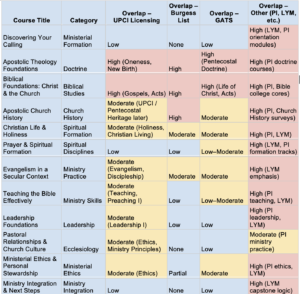
| Course Title | Category | Overlap – UPCI Licensing | Overlap – Burgess List | Overlap – GATS | Overlap – Other (PI, LYM, etc.) |
|---|---|---|---|---|---|
| Discovering Your Calling | Ministerial Formation | Low | None | Low | High (LYM, PI orientation modules) |
| Apostolic Theology Foundations | Doctrine | High (Oneness, New Birth) | High | High (Pentecostal Doctrine) | High (PI doctrine courses) |
| Biblical Foundations: Christ & the Church | Biblical Studies | High (Gospels, Acts) | High | High (Life of Christ, Acts) | High (PI, Bible college cores) |
| Apostolic Church History | Church History | Moderate (UPCI / Pentecostal Heritage later) | High | Moderate | High (PI, Church History surveys) |
| Christian Life & Holiness | Spiritual Formation | Moderate (Holiness, Christian Living) | Moderate | Moderate | High (PI, LYM) |
| Prayer & Spiritual Formation | Spiritual Disciplines | Low | Low | Low–Moderate | High (LYM, PI formation tracks) |
| Evangelism in a Secular Context | Ministry Practice | Moderate (Evangelism, Discipleship) | Moderate | Moderate | High (LYM emphasis) |
| Teaching the Bible Effectively | Ministry Skills | Moderate (Teaching, Preaching I) | Low | Low–Moderate | High (PI teaching, LYM) |
| Leadership Foundations | Leadership | Moderate (Leadership I) | Low | Low | High (PI leadership, LYM) |
| Pastoral Relationships & Church Culture | Ecclesiology | Moderate (Ethics, Ministry Principles) | None | Low | Moderate (PI ministry practice) |
| Ministerial Ethics & Personal Stewardship | Ministerial Ethics | Moderate (Ethics) | Partial | Moderate | High (PI ethics, LYM) |
| Ministry Integration & Next Steps | Ministry Integration | Low | None | Low | High (LYM capstone logic) |
Next Steps
- Confirm consensus
Validate that MVP1.1 is fully compatible with the ER intent and need as pastor-safe, non-competitive with licensing/PI/GATS, and has no blocking objections.
- Formally adopt MVP1.1
Approve the 12-course structure as the selected pre-license formation pathway and freeze scope. If changes are desired, create a MVP1.2.
- Assign ownership and responsibilities
Designate a curriculum owner and implementation lead with clear authority to proceed. Set up an initial team to start the work. This should provide particular emphasis on the more intensive portions of the project – Instructor Engagement, Technical Setup, and Content Management, for example.
- Engage Instructors
Engage instructors with MVP1.1 – or whichever level we settle upon – and collaborate with them each balancing our intent and their input to determine the “executable” content for each course and each lesson. We will start working with them on a course outline based on our initial descriptions and direction, receive their feedback and adaptations, process that, and set down the material for them to then teach in 2 video sessions per course. We will need to work with them as well to work towards also working up visual aids that will augment the personal teaching video content.
- Pilot deliberately
Run a limited regional pilot to validate clarity and pastoral confidence.
- Launch with clarity
Incorporate essential pilot fixes, finalize MVP1.1, and communicate its role and boundaries clearly to pastors and leaders throughout Europe.
Appendix
MVP1: a synthesis of best practice and content
Origin of MVP1 (Original Version)
MVP1 was created as a minimum viable, pre-license training pathway for Europe by:
- Surveying existing MinistryCentral “Launch Your Ministry” content and UPCI licensing structures to identify foundational themes.
- Selecting 12 core topics that recur across Apostolic ministry formation (calling, doctrine, spiritual life, evangelism, leadership, ethics).
- Reducing each topic to a single, one-hour learning unit (2 × 30-minute videos) to lower participation and production barriers.
- Prioritizing formational readiness over academic depth, focusing on new or unlicensed ministers rather than credentialed clergy.
- Designing the sequence as an on-ramp, not a replacement, for Local and General License training, Purpose Institute, or GATS.
- Abstracting content from language, culture, and delivery method, allowing later localization without altering theological substance.
In short: MVP1 was constructed by distilling common Apostolic formation essentials into a lightweight, pastor-safe entry pathway aligned with existing credentialing systems but intentionally non-academic.
Criteria for MVP1
- Foundational (not advanced)
- Formational (not merely academic)
- Recognized as “safe and sufficient” by pastors
The MVP1 List
This list was sent about the same time that Bro Turner sent the list from Bro Burgess. See the full compiled list here:
| Discovering Your Calling | Ministerial Foundations (MVP1) | Sayers | Lesson 1: What Is a Call to Ministry?; Lesson 2: Confirming, Developing, and Responding to the Call | Entry point for ministry discernment; aligns with Minister’s Calling themes found later in credential tracks |
|---|---|---|---|---|
| Apostolic Identity & Doctrine Essentials | Doctrine (MVP1) | Sayers | Lesson 1: Oneness of God & Apostolic Identity ; Lesson 2: The New Birth & Authority of Scripture | Foundational Apostolic theology; prepares for The Oneness of God and The New Birth (Local License) |
| Spiritual Foundations for Ministry | Spiritual Formation (MVP1) | Sayers | Lesson 1: Character, Purity, and Personal Weaknesses ; Lesson 2: Temptation, Integrity, and Relationships | Holiness and character emphasis; doctrinally aligned with UPCI Christian Living / Holiness |
| Educational Growth & Learning Discipline | Personal Development (MVP1) | Sayers | Lesson 1: Building a Personal Ministry Learning Path; Lesson 2: Mindset, Self-Discipline, and Growth | Meta-learning course; prepares students for PI, GATS, or license-level study |
| The Life of Prayer for Ministers | Spiritual Disciplines (MVP1) | Sayers | Lesson 1: Personal Prayer and Hearing God; Lesson 2: Intercession, Healing, and Crisis Prayer | Applied prayer theology; aligns with later ministerial development courses |
| Evangelism & Personal Testimony | Ministry Practice (MVP1) | Sayers | Lesson 1: Sharing Your Testimony Effectively; Lesson 2: Inviting, Connecting, and Following Up | Practical evangelism; culturally adaptable to European secular contexts |
| Teaching the Bible Effectively | Ministry Skills (MVP1) | Sayers | Lesson 1: Teaching a Home Bible Study – Structure; Lesson 2: Teaching for Transformation | Prepares for Teaching Home Bible Studies and future preaching courses |
| Pastoral Relationships & Church Ethics | Church Life & Ethics (MVP1) | Sayers | Lesson 1: Loyalty, Faithfulness, and Submission; Lesson 2: Pastor as Mentor and Spiritual Authority | Ecclesiology in practice; aligns with Pastoral Respect concepts |
| Leadership Essentials (Level 1) | Leadership (MVP1) | Sayers | Lesson 1: Servant Leadership & Reliability; Lesson 2: Fivefold Ministry Overview | Entry-level leadership; prepares for Leadership I (General License) |
| Ministerial Ethics & Personal Life | Ministerial Ethics (MVP1) | Sayers | Lesson 1: Ethics, Boundaries, and Accountability; Lesson 2: Time, Family, and Personal Stewardship | Early ethics grounding; precedes formal Ethics courses |
| Foundations of Church Work & Service | Church Operations (MVP1) | Sayers | Lesson 1: Teamwork, Communication, and Service; Lesson 2: Supporting Vision and Local Ministry Systems | Practical church engagement; bridges volunteers → ministers |
| Apostolic Church History (Intro) | Church History (MVP1) | Sayers | Lesson 1: Early Church to Pentecostal Movement; Lesson 2: Modern Apostolicism & Europe | Introductory history; prepares for History of the UPCI and Pentecostal Heritage |
The “Burgess” List
Brother Ken Burgess offered – likely with the collaboration of Brother Turner – a list of 20 courses. This was sent from Bro. Turner.
| Topic | Category | Contributor |
|---|---|---|
| The Minister and his/her Marriage | FAMILY | Burgess |
| The Minister and his/her Children | FAMILY | Burgess |
| The Minister’s Home Life | FAMILY | Burgess |
| The Minister and Time Management | FAMILY | Burgess |
| Prayer & Fasting | PERSONAL DEVELOPMENT | Burgess |
| Spiritual Growth & Goals | PERSONAL DEVELOPMENT | Burgess |
| Health & Personal Care | PERSONAL DEVELOPMENT | Burgess |
| Ethics & Integrity | PERSONAL DEVELOPMENT | Burgess |
| The Minister and Finances | ADMINISTRATION | Burgess |
| Meetings & How to Conduct them | ADMINISTRATION | Burgess |
| Church Structure | ADMINISTRATION | Burgess |
| The Art of Delegation | ADMINISTRATION | Burgess |
| Your Calling & Anointing | MINISTRY | Burgess |
| Homiletics & Bible Interpretation | MINISTRY | Burgess |
| Holiness | MINISTRY | Burgess |
| Spiritual Gifts & Giftings | MINISTRY | Burgess |
| Home Groups | DISCIPLESHIP | Burgess |
| Training Others to Lead | DISCIPLESHIP | Burgess |
| Team Building | DISCIPLESHIP | Burgess |
| Altar Work | DISCIPLESHIP | Burgess |
Burgess Class Overlap with Local + General
| Area | Overlap Level | Explanation |
|---|---|---|
| Doctrine | High (≈70–80%) | Same core subject matter (Godhead, salvation, doctrine development), different depth and framing |
| Biblical Studies | High (≈75%) | Acts, Gospels, Epistles, OT surveys strongly overlap |
| Church History | Moderate (≈40–50%) | Burgess is broader; licensing is UPCI-specific |
| Christian Living / Ethics | Low (≈20–30%) | Licensing is pastoral/ethical; Burgess is theological |
| Leadership | Minimal (≈10–15%) | Licensing is practical; Burgess largely absent |
| Ministry Practice / Skills | Minimal (≈10%) | Evangelism, preaching, leadership largely outside Burgess scope |
Overall weighted overlap
➡️ ≈45–50% content overlap,
➡️ but only ≈30% functional overlap (because purpose differs).
High-overlap examples (substantive)
| License Course | Category | Burgess Equivalent | Notes |
|---|---|---|---|
| The Oneness of God (Local) | Doctrine | Systematic Theology / Godhead | Same doctrine, Burgess is more academic |
| The New Birth (Local) | Doctrine | Salvation Theology | Licensing is confessional; Burgess analytical |
| Acts (Local) | Biblical Studies | Acts / Early Church | Strong overlap |
| Gospels (Local) | Biblical Studies | Life of Christ | Strong overlap |
| Epistles of Paul (General) | Biblical Studies | Pauline Theology | Strong overlap |
| History of Doctrine (General) | Doctrine / History | Historical Theology | Strong overlap |
Low-overlap examples (important distinction)
| License Course | Category | Burgess Coverage | Why it matters |
|---|---|---|---|
| Leadership I | Leadership | Minimal | Burgess not ministry-leadership focused |
| Preaching I / II | Ministry Skills | Minimal | Homiletics ≠ theology |
| Ethics | Christian Living | Partial | Pastoral ethics ≠ moral theology |
| Discipleship | Ministry Practice | Partial | Burgess is descriptive, not formative |
| History of the UPCI | Church History | None | Denominational specificity |
“Burgess List” overlap with MVP1
| MVP1 Area | Burgess Coverage | Decision |
|---|---|---|
| Apostolic Doctrine Essentials | Strong | Replace content, keep MVP1 framing |
| Biblical Foundations (Acts, Gospels) | Strong | Replace content |
| Church History (Early / Apostolic) | Strong | Replace content |
| Christian Living (general) | Moderate | Supplement |
| Calling & Discernment | Weak | Keep MVP1 original |
| Prayer & Spiritual Formation | Weak | Keep MVP1 original |
| Evangelism (theory) | Moderate | Supplement |
| Teaching / Home Bible Studies | Weak | Keep MVP1 original |
| Pastoral Relationships | None | Keep MVP1 original |
| Leadership Foundations | Minimal | Keep MVP1 original |
| Ministerial Ethics (practical) | Partial | MVP1 emphasis |
| Church Service & Operations | None | Keep MVP1 original |